
Mimetic Renderings: On the Paintings of Sophia Lapres
16 March 2026By Violet Pask

Sophia Lapres doesn’t paint memes—at least, not as we might culturally understand them today. Her pop culture references skew more towards the saccharine and the cliché than the humorous, towards Pinterest and Tumblr rather than Reddit and Twitter. Nevertheless, her work is born of the same endless replicability of the image in the digital age that defines the modern meme: most of Lapres’ paintings are based on pre-existing images, found online, in magazines, or made by other artists. The artist often replicates widely shared source material that is already imbued with its own cultural caché. Here, replicability, as opposed to a more traditional understanding of worth based in rarity, individuality, or uniqueness, is what generates meaning and creates value. Her paintings do not produce meaning internally, but seem instead to inherit it through the cultural diffusion and series of duplications her source material has already undergone. Lapres’ work is a recreation not only of the image’s associated affect, its overladen symbolism and cultural caché, but a formal recreation of this meaning-generating system. By self-consciously rendering this very process, Lapres’ paintings become more than reflections or replicas. They are both recreations and interventions, allowing her to deform the very memetic process she represents, and produce an aesthetic and affective experience that is all her own.
In her most recent body of work, Lapres’ investment in the replicability of appropriated images pushes the referential nature of her work into new formal territory. 1c2d94ca50aba4f6eace078a2ca3bacf.gif (GIF 1) [2025], is a series of thirty paintings representing the 35-ish frames of the titular gif. The depiction of a moving image in this manner is new for Lapres, and this format both epitomizes and further develops the thematic questions her work investigates: can repetition be a form of meaning-making, or is it instead an emptying out of meaning, leaving behind only the superficial? For Lapres, the repetition itself is meaningful enough.
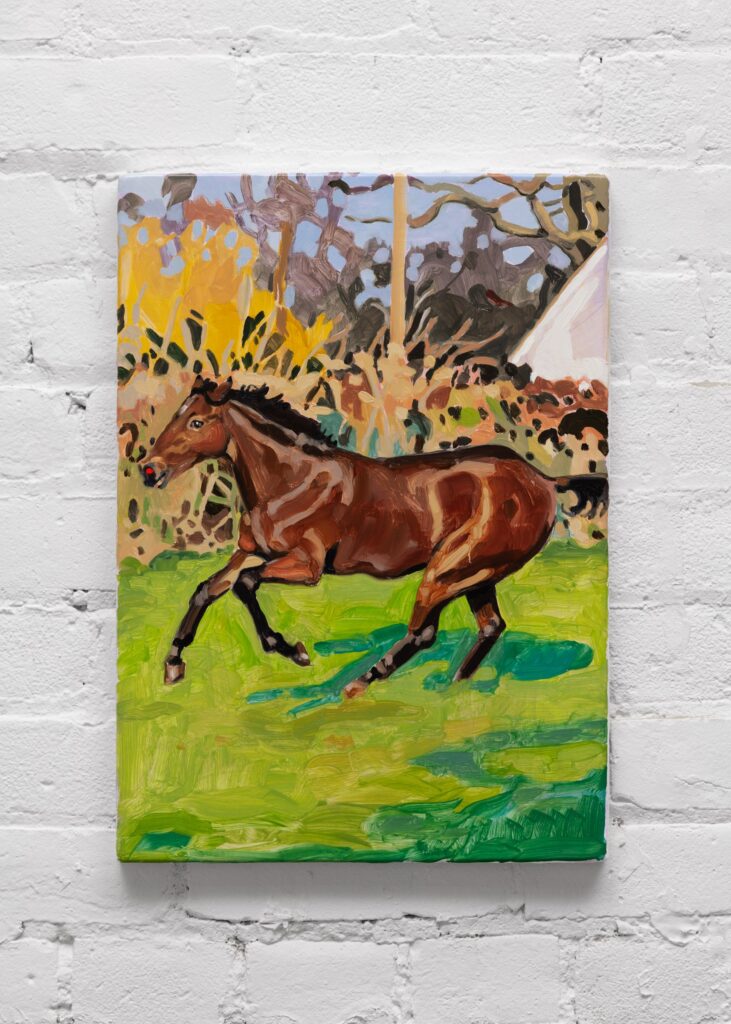
The artists imagistic heritage is just as memetic as more ubiquitous meme formats, but from a traditionally feminized digital space: social media platforms such as Pinterest and Tumblr are built entirely on repetition and duplication, the sharing of an image over and over again, pinned to a board or re-blogged to your page. As these images are decontextualized through reposting, they take on a cultural life much broader than what they literally depict, but are simultaneously flattened into a pure stream of information. For example, within a “spring 2025 outfit inspo” board, or a 2010s-era American Apparel-ish Tumblr blog, images become indistinguishable from their heavy-handed overarching curation. Lapres’ choice of content is not purely appropriation, but also a mode of curation akin to that which occurs in the social media platforms described above. Her paintings emulate a contemporary “aesthetic” as understood in our vernacular—that is, as an ambiguous gesture towards some kind of cohesive, aspirational, style defined by the Internet’s collective mood board. Even the most cliché images, as depicted by Lapres, be it a galloping horse, (Live Forever, 2024), or two swans forming a heart on a sun-dappled pond (He holds me aloft like a child and we coo to each other around our home, 2022) are now embedded with an “I-almost-forgot-this-is-the-whole-point” sensibility, as all images blur together into something they seem to stand for—something vaguely purchasable.
In the artist’s paintings in her solo exhibition Mixed Blessings at Towards Gallery in 2024, Lapres uses cliché to overlap pop culture with art-world references. The couple embracing passionately in We grew up with our tongues pressed so firmly against our cheeks it’s no wonder we all needed braces (2024), evokes the unnamed couple in “V-J in Times Square” (1945), or Noah and Allie in “The Notebook” (2004), (however, the painting is actually based on the the kiss in “Never Been Kissed,” 1999), while the sunburnt and glowing backs of bathers in He stared fondly at their freckled backs (2024) is vaguely reminiscent of Alex Colville’s depictions of beachgoers, their faces turned away from the viewer and towards each other or the scenery.

In other instances, Lapres’ references get more specific. The idyllic rainbow over a white farmhouse in We’ll have a white picket fence and a modest art collection and a dog and a clothesline (2024) is a direct recreation of Wolfgang Tillmans’ photograph, Shaker Rainbow (1998). However, every one of these images take on a new life in Lapres’ hands: where the original Tillmans photograph has a grainy, hazy realism, with telephone wires cutting across the sky, Lapres’ version is vivid, even surreal. Oil paint shines, mimicking cinematic late afternoon sunlight, whites aglow, and colours leap off her aluminium panel. Instead of the layers upon layers of paint a traditional canvas surface takes to produce this sense of saturation and sheen, Lapres’ choice of material seems to resist the paint, allowing it to sit only on the surface. Her broad, gestural strokes remain visible, showing even the individual hairs on her brush, and drip marks streak through them, as if the paint could slip right off the canvas. This materiality grounds her pieces by enhancing their particularities. However, when seen with the exhibit as a whole, these particularities are subsumed by the overall effect—your sense of déjà vu is not from the particular, but from a recognizable, curated, “vibe.” Have I seen this sunset through an airplane window before (such as in I only travel with my credit card, 2024)? The answer is yes, in thousands of different iterations of social media vacation carousels and Instagram stories. There is a saccharine sweetness, a rose-coloured tint to Lapres’ work that is most effective when specificity and circumstance evade us. Any sense of a reality beyond the immediacy of the image seems to lurk beyond the edge of the frame. A context we aren’t privy to threatens to dampen the overall effect.
While Lapres doesn’t paint immediately recognizable images, her gestural, dare I say, vibe-based relationship to her inspiration creates a sense of nostalgia, or déjà vu, as if squinting might bring to the viewer the source of their sense of recognition from some hidden, internal stores of memory. She leaves viewers struggling to pinpoint an unnamed time and place in the pop culture memory bank, blurring remembered experiences with acts of aesthetic cultivation. Lapres capitalizes on this affective nostalgia. Her paintings parasitically consume and reflect the emotional responses this referentiality elicits in the viewer, manifested in the hard, smooth, reflectiveness of her metal surface, akin to a mirror. By making the traditional painting process more tactile, Lapres produces a new kind of kitsch, one that is born of the infinite replicability of the image in the digital age.

While Lapres’ work doesn’t always conform to the aesthetic features of kitsch—that is to say, overly cute, melodramatic, or garish—if we think about the effect of kitsch, it becomes much easier to pinpoint how Lapres evokes a particularly contemporary iteration of it. Kitsch is an aesthetic defined by the collapse of critical distance between object and observer in favour of immediate emotional responses, making use of nostalgia to produce this reaction. Nostalgia is an easy effect to produce, and is almost cheap in its cloying manipulation of affect. It bypasses criticism by means of sentimentality—which Lapres exploits in the viewer. She mines the popular appeal of the contemporary low to middle brow, specifically online aesthetics produced by and for a mass market. In his definition of kitsch, Modernist writer Hermann Broch argues that its essence is imitation, not only of the “higher” art forms it attempts to replicate, but also its capacity to be mass reproduced and consumed. It is not merely imitation that defines kitsch, but imitation for the purpose of serving the market.1 Kitsch is also produced by having a referential location, something about which there has been some kind of critical social consensus: something in time. This is where Lapres intervenes: her locations collapse time like an accordion, rendering the endless reproduction of the images that inspire her. The artist plumbs the affective collapse between object and observer, where time seems to fold over on itself, and produces misplaced remembrances whose only location is a vague aesthetic sensibility.
In 1c2d94ca50aba4f6eace078a2ca3bacf.gif (GIF 1) (2025) each frame of the same GIF is rendered on its own panel, creating a 30 panel series displayed like a contact print. However, instead of the flattening effect of the overall aesthetic, where each image is subordinated to its selection, to the act of curation, here, repetition brings the attention of the observer back to the particulars of each iteration. While the first few panels showcase a picturesque scene, by the 6th and 7th panels, the light has changed. By the 13th panel, even the light has taken on a more graphic style, shine painted on like a mop of Lichtenstein hair. Just as a photocopy or a screenshot degrades the more it is replicated, the repetition of the sheen and glow of sky blue pool water gives way to a darker, shadowy version of the same scene. The subsequent paintings offer a more close-up perspective, but instead of becoming clearer, the details of the image become even more hazy, overtaken instead by painterly effects. What was once smooth, wet, skin, becomes the artists’ brush strokes in shades of purple and green. Where in the beginning we see eyebrows, eyelashes, cheekbones, we now see only planes of light and shadow. The cohesive imagery of the source material is broken down into its essential components.
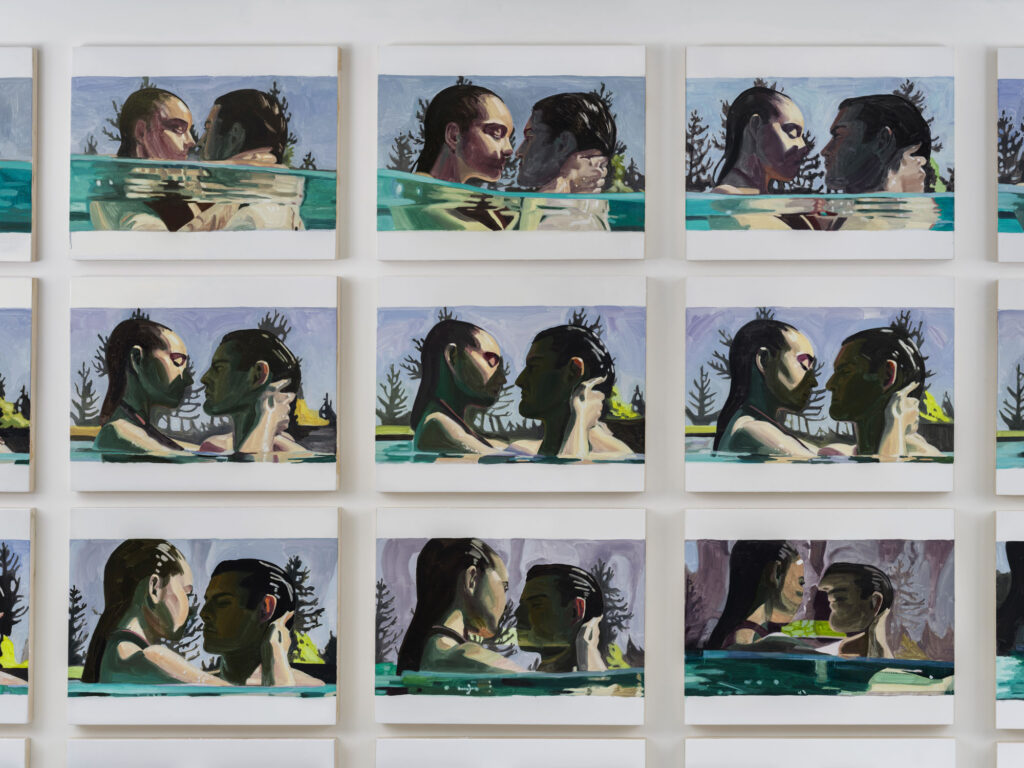
By rendering each single frame within the GIF, Lapres allows the differences in each panel to play out at a slower pace. The viewer is invited to spend more time contemplating the individual frames, to notice how the colours, light, and texture change from one panel to the next, and how these changes alter their effect. In doing so, Lapres re-introduces the distance between object and observer that kitsch collapses. In this way, time is incorporated into the painting: the smoothness of movement is broken down by the disjointed ways each panel relates to one another. Rather than the sensation that the images together tell a story larger than the sum of their parts, the image itself begins to disintegrate, losing comprehensive form and detail, becoming a sum of painterly effects. The resulting aesthetic experience is unnerving, not sentimental or nostalgic. What might have sat outside the frame of her previous work is now forced into focus, souring the sweetness. However, it is not the previously missing context of the image that brings out the edginess that Lapres’ other work lacks. It is that very same lack of context now made explicit. The invitation to dive into what at first appears to be added depth reveals itself to be an illusion laid over a disturbing emptiness, an emptiness in which the artist revels.
Where her previous work remains pleasant and pretty, dancing around the void that she invokes, here, Lapres instead generates the vacuum-like force that pulls the viewer into this abyss, marrying her capacity to render the superficial with what lurks underneath. By pushing the bounds of her practice both physically and thematically, Lapres has created a series that builds on the very act of repetition to successfully reveal not a rotten core, but a lack of any core whatsoever. Kitsch and nostalgia are worked to the point of meaninglessness, losing any external reference point. Even the work’s title is a meaningless code as opposed to a narrative framework—just a series of numbers and letters that together might lead you to some broken link. The image the artist depicts is drained of its symbolic power, and we are left with only the painted surface to contend with.
- Hermann Broch, “Evil in the Value System of Art,” in Geist and Zeitgeist: The Spirit in an Unspiritual Age: Six Essays by Hermann Broch, ed. John Hargraves (New York: Counterpoint, 2002), 3-40.
Mixed Blessings by Sophia Lapres ran from October 10 – November 16, 2024 at Towards in Toronto, ON.
Feature Image: Sophia Lapres, 1c2d94ca50aba4f6eace078a2ca3bacf.gif (GIF 1), 2025, oil on wood panel, 88 x 130 in. Photo courtesy of the artist.